

Walnut grower future-proofing operations with focus on sustainability
GoldRiver Orchards built a reputation for quality. Learn how the walnut grower is incorporating technology to advance sustainability goals.
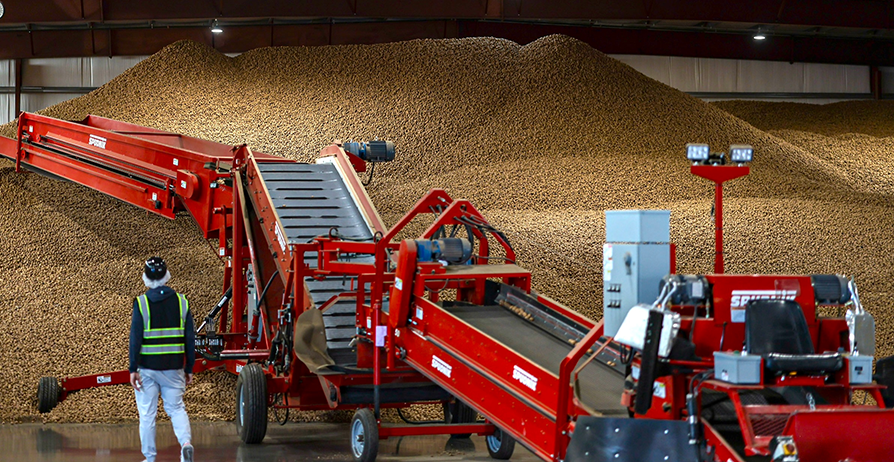
For more than a hundred years, the Barton family has been a cornerstone of California’s walnut industry. Based in Escalon, GoldRiver Orchards has built a reputation for quality, reliability and respect for the land.
Today, that heritage lives on under the guidance of Jeremy Barton, a fifth-generation grower who is blending tradition with innovative technology to steer the company into a new chapter.
For instance, GoldRiver Orchards utilizes optical sorting machines throughout its operation.
“We just purchased our first AI-based sorter and continuously stay on top of where the technology is improving,” Barton said. “To be honest, though, as nifty as the sorters are — and they are nifty — mechanical processes are still critical. We aim to have one piece of foreign material for every 2,500 hundred pounds of walnut kernel in our finished goods, and you cannot do so through electronic sorting alone.”
The trick to achieving such an ambitious goal is to calibrate the speed, settings and movement of walnuts from one machine center to the next, Barton said.
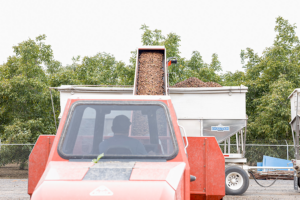
“A fancy sorter does you no good if you are pushing your machines to the limit by overwhelming or starving them with product,” Barton said. “For us, quality does not just mean achieving a quality product — it means optimizing a quality process. Our operators are measured on their ability to balance speed versus target specification. Slower is faster when it comes to walnuts because of how delicate they are compared to almonds or pistachios.”
TECH MINDSET
Barton didn’t start in agriculture. He worked in tech earlier in his career, and that experience taught him the value of systems and analytics.
“We’re bringing a lot of innovation into our operations by upgrading our tech stack, building efficiencies and driving down costs, which ultimately gets better returns back to the growers,” he said. “The data integration is critical for quality assurance and traceability efforts during processing.
“I’ll credit my grandfather with being the first person that told me that ‘You can’t improve what you can’t measure.’ And I’ll credit Doug Hoogervorst, the founder of the business intelligence firm where I worked, with showing me that you can’t measure what you can’t see.”
By consolidating and connecting the tech stack through the data warehouse, GoldRiver Orchards has reduced the cost and effort to validate its inventory daily and catch errors in real time.
“The integrity of our processing transactions has improved by over 90% in less than three years because managers can access information more quickly and provide feedback to operators immediately,” Barton said. “The speed of that feedback loop significantly improves the accuracy of our lot transactions and thereby improves our traceability. It has also cut down the time to complete a trace exercise in a mock recall by over 90%.”
FOCUSING ON FOOD SAFETY
Beyond hazard analysis and critical control points (HACCP) and the Global Food Safety Initiative’s SQF safety certification programs, Barton believes that caring about the process and product is fundamental to food safety.
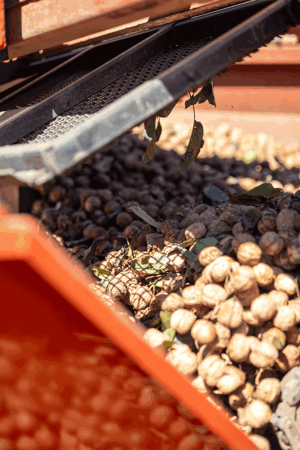
“When you are manufacturing at high speeds, it is easy for the team to forget that we’re not producing widgets — we’re producing food,” he said. “A disciplined approach is required to maintain awareness across our team that our products will eventually be consumed by someone’s son, mother, brother, grandmother, husband, girlfriend, etc.
“The sorting technology and food safety programs are the result, not the catalyst.” Korea and Japan are among GoldRiver’s most important markets, and both demand exacting specifications.
“It is honestly very simple to meet the standards — we care,” Barton said. “If you don’t care, you won’t invest in the people, training, process improvement, sorting technology, and information technology and food safety programs necessary to meet the highest level of spec. We built a brand on caring about food safety, food quality and a desire to highlight the taste profile of a walnut.
“Yes, we are trying to build brand awareness through LinkedIn, Instagram and other means, but at the end of the day, our brand is built by what’s in the box. When you open a box of GoldRiver Orchards walnuts, we want you to know how much we care about what is inside.”
BIOCHAR INNOVATION
Recently, GoldRiver Orchards moved into new territory with an innovative joint venture that turns walnut shells into biochar for soil supplementation — a process that also captures carbon and can generate additional energy for plant operations.
While the concept is still in a development phase, Baron shared details about its near-term aspirations.
“We generate roughly 7,500 tons of walnut shell waste each year through our shelling process,” he said. “That shell is a rich, consistent source of biomass that is ideal for industrial processes. Our goal in this partnership is to generate a rich biochar on site by utilizing a pyrolyzer to
compress the shell into a pure carbon charcoal that can be used as a soil amendment or industrial water filter.”
Pyrolysis converts organic material into valuable products such as biofuels, bio-oil, bio-char and syngas through thermal decomposition in the absence of oxygen. The zero-emissions process not only reduces waste at GoldRiver Orchards but also provides the end product to a California winery to use in its vineyards on a long-term contract.
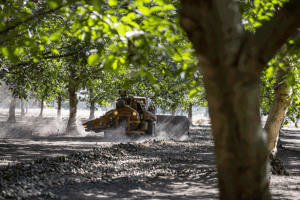
“Instead of throwing away the shell, we are going to hit a grand slam by reducing our waste, reducing our energy costs, improving soil health and monetizing our shell,” Barton said. “This improves the environment while also improving grower returns.
“Being green shouldn’t be about sacrificing your bottom line for a moral goal. It should be about innovating novel solutions that ensure we have a sustainable future and improve the bottom line today.”
STAYING SUSTAINABLE
At GoldRiver Orchards, 85% to 90% percent of energy is covered by solar. The company has also long practiced efficient water management, matching soil types and topography to ensure the best results from drip irrigation and strategic flood systems.
For Barton, stewardship of the land is both an ethical responsibility and a smart business strategy.
“I’m a capitalist, and unabashedly so,” he said. “Businesses create jobs, wealth and prosperity. However, to do so over the long run, a business must manage a sustainable business model. IBM, Coca-Cola, GE, Goldriver Orchards — we’ve been around for generations and plan to be around for generations more. Ask any grower what happens if you deplete the health of your soil, your water sources, your balance sheet. It means your income stream dries up.”
Sustainability doesn’t mean sacrificing profitability, Barton said.
“It’s about innovating ways to monetize waste streams, more efficiently extracting value from natural resources and ensuring that we invest in a sustainable business that will allow my daughter, my future granddaughter and my future great-granddaughter to provide jobs to this community by growing world-class food,” he said.